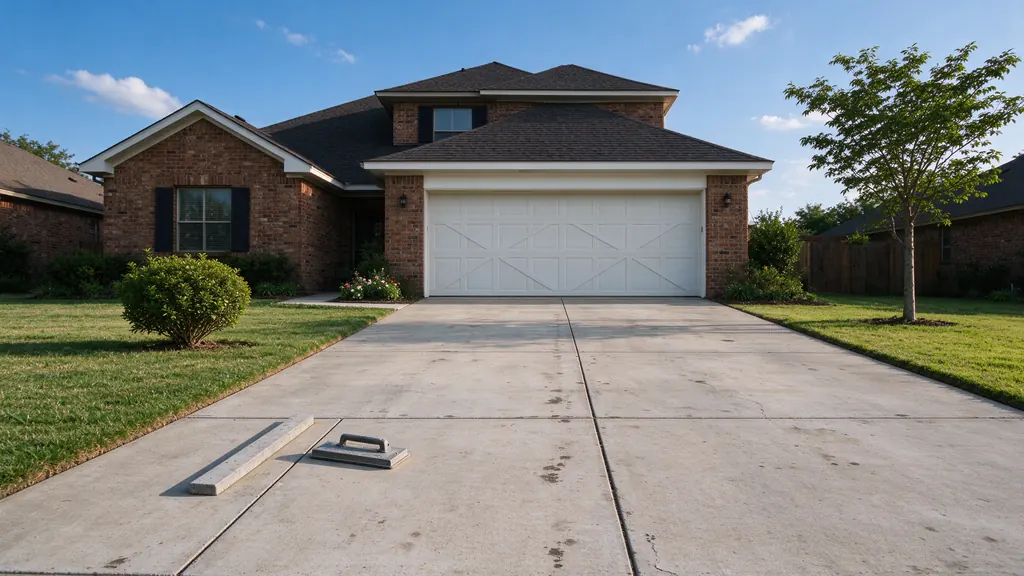
A broken panel at the garage makes every arrival a jolt. A gravel entrance that turns muddy after rain can leave you wondering whether another load of stone will help. We help Cypress property owners work out what needs fixing, then manage the repair around the way the property is used.
Surefoot Houston Driveway Repair offers concrete, asphalt and gravel driveway repair in Cypress for homes and commercial properties. We manage work fulfilled by licensed and insured contractors, including any trade licensing required for the permitted scope. Tell us where the problem starts and what vehicles use the entrance.
If your business entrance connects directly to a US 290 frontage road, tell us before we price work at the street. A patch farther inside the property and a revised highway-access driveway should not be grouped together without checking the repair limits. TxDOT's Houston District has a driveway-access permit process. We identify the road authority and whether the proposed work affects state right-of-way; simply being near US 290 does not make every driveway a TxDOT project.
Planning work at a Bridgeland home
In Bridgeland, send the village name with the street address, whether that is Lakeland, Parkland, Prairieland or Creekland Village. The community spans different residential areas with Grand Parkway access, so “near Bridgeland” is not enough to plan an arrival or material delivery. Show us the entrance, sidewalk crossing and finish you want to retain. If you have association conditions or an approval letter for exterior changes, include them before we settle the replacement boundaries. We do not assume every village uses the same driveway specification.
Cypress Creek drainage and a puddle on the slab
Cypress Creek and its Little Cypress Creek subwatershed are part of the area's wider drainage setting. Harris County Flood Control's Little Cypress Creek page provides watershed and floodplain resources. That is a different scale from water left in a low driveway panel. Tell us whether water stays on the slab, backs up from the roadside or arrives across the property. We can discuss pavement levels and visible drainage conflicts, but a driveway repair is not a promise to resolve creek flooding or protect a building from a regional storm.
Start with the driveway, then check the entrance
For a Cypress project, the address and the street connection both matter. Repairing a panel near the house can be a different scope from rebuilding an entrance over a roadside ditch. We plan for the actual entrance.
Before an estimate, take one photograph looking toward the road and another looking toward the property. Add close-ups of the damage. If water stands at the entrance, a photograph taken after rain can show something a dry-day visit would miss.
Concrete, asphalt and gravel repair options
Concrete panels, cracks and joints
A cracked concrete driveway does not automatically need complete replacement. We consider the affected panels, the surrounding concrete and whether the problem is limited to an opening or includes movement. A suitable settled slab may be a leveling candidate. A badly broken panel may need removal and replacement. Concrete resurfacing is a separate option for suitable concrete; it does not rebuild failed support underneath.
An open joint and a crack through a panel need different preparation. A joint is a planned separation; a crack is a break in the concrete. Filling either opening does not lift a sunken slab. If selective replacement is appropriate, we discuss the boundary and finish before removal because new concrete can remain visibly different from the sections retained. See concrete driveway repair for how those treatments compare.
Asphalt patches and worn surfaces
With asphalt, a localized damaged area and a generally worn surface need different conversations. We look at the extent of cracking, edge condition and any visible rutting before recommending the scope. An isolated patch may suit one area while an overlay or replacement is considered elsewhere. Sealcoating is maintenance for appropriate pavement, not a structural repair for an entrance that is breaking apart.
If delivery trucks or trailers use your entrance, mention that at the outset. The vehicles using the driveway belong in the planning discussion. Our asphalt repair page explains the service options, and the sealcoating versus resurfacing guide separates two commonly confused treatments.
Gravel, crushed aggregate and unpaved access
We offer gravel driveway repair and regrading as well as conversion to pavement. When tires push loose aggregate aside, reshaping suitable material may help restore the surface. If the ground below stays soft, another layer of stone can settle into the same rut. The repair needs to distinguish displaced surface material from weak support.
Water matters here too. Flow across an unpaved entrance can carry material toward its edges, while a low area holds water where vehicles repeatedly pass. We look at the driveway shape and its connection to the road before settling the regrading scope. Work on a roadside ditch or culvert is a separate decision; it is not automatically included in gravel restoration.
Cypress address, project-specific permit checks
We do not use a Cypress mailing address alone to decide which authority controls the work. The parcel, road and repair limits need to be identified first.
Harris County states that driveway construction within county right-of-way requires a permit. Its residential application process calls for an accurate, detailed site plan, including when the driveway crosses a ditch in that right-of-way. Commercial pavement reconstruction in county right-of-way can require additional precinct review.
Those rules should not be turned into a blanket answer for every crack repair. We confirm the proposed scope with the applicable authority and identify permit responsibility before work starts. See the Harris County permit FAQ and our driveway permit guide.
How we plan a Cypress driveway repair
Start with the address and a description of what changed. We review the affected surface, adjoining levels and visible drainage concerns, then define the proposed repair. If work reaches the street connection, we resolve that part of the scope separately from the private driveway. The estimate should explain any condition that cannot be confirmed until pavement is removed.
At a home, think about where cars will be parked while the affected area is unavailable. Tell us about a garage you need to reach, a gate that limits equipment access or anyone who needs a clear walking route. We discuss the work area and return-to-use instructions before the job begins. Walking on a surface and parking a vehicle on it are different milestones.
For commercial driveways, share delivery windows, customer entrance needs and the type of vehicles using the property. A workable sequence depends on the layout. We will discuss whether the proposed work can be divided into sections, rather than promising that every entrance can remain open throughout construction.
What your estimate should explain
A useful driveway estimate describes the work, not just a total. We want you to be able to point to the affected areas and understand what the price covers. For replacement work, that includes what will be removed, how the base will be addressed, what finish is proposed and how the repair joins the surfaces that remain.
The measured repair area and material being treated.
Preparation, removal and disposal included in the scope.
Any allowance or separate decision for concealed base problems.
Entrance, drainage or permit items included or excluded.
Access arrangements and instructions for returning to normal use.
For planning context, the Houston driveway cost guide explains available local budget information and the factors that change it. A Cypress address alone does not establish a price, and a whole-driveway square-foot figure is not a substitute for defining the repair.
Where rain exposes the problem, our driveway pooling guide explains the difference between a low slab and water arriving from elsewhere.
Cypress driveway repair questions
Does a Cypress mailing address identify the permit authority?
No. The parcel and road authority need to be checked. A Cypress postal address does not, by itself, tell us who controls the entrance or which approvals apply. We identify the repair limits first so work on private pavement is not confused with work in a public right-of-way.
What changes if my entrance connects to a US 290 frontage road?
The street connection needs a state-road access check. TxDOT's Houston District has a driveway-access permit process, so proposed work at that connection must be distinguished from a repair farther inside your property. Being close to US 290 is not enough on its own to make a private driveway a TxDOT project.
What should I include for a driveway project in Bridgeland?
Include the street address and village name, together with photographs showing the driveway's entrance and sidewalk crossing. Send any association conditions you have already received for the proposed exterior work. That lets us discuss the finish and repair boundaries against your actual requirements without assuming a common specification across every village.
Does living near Cypress Creek mean a low driveway is a flood problem?
No. Proximity to the creek does not explain a particular low spot. Water held on a settled panel is different from water arriving across the property or backing up from the road. Describe what happens during rain so pavement repair can be separated from a wider drainage concern. Repairing a driveway does not establish flood protection.
Can a driveway crossing a roadside ditch be treated as an ordinary patch?
Only after the work limits are understood. A surface defect may be separate from the condition of the crossing beneath it. If the proposal involves a ditch, culvert or public right-of-way, that work needs its own scope and approval checks. We do not treat a layer of pavement as a repair for a failing drainage crossing.
Is there a separate Cypress price for concrete leveling?
We have not established a separate Cypress rate. For suitable residential slab areas, the Houston-area planning range is $500–$2,500 or more per project. The condition of the affected slabs and access for the work determine whether that range is useful for your property. It is not an allowance for replacing the entire driveway.
You do not need to choose the repair before contacting us. Show us the damage, explain how the driveway is used and tell us what you want to improve. We will help define the next step.