
Houston driveway services
Driveway drainage in Houston
Driveway drainage work in Houston controls where water goes on and around the driveway: regrading the surface so it sheds water, adding a trench drain where water runs toward a garage, routing downspouts away from the pavement and keeping roadside culverts and gutters clear at the entrance. On flat clay ground, water left standing against a driveway weakens the support that the pavement depends on.
Get an Estimate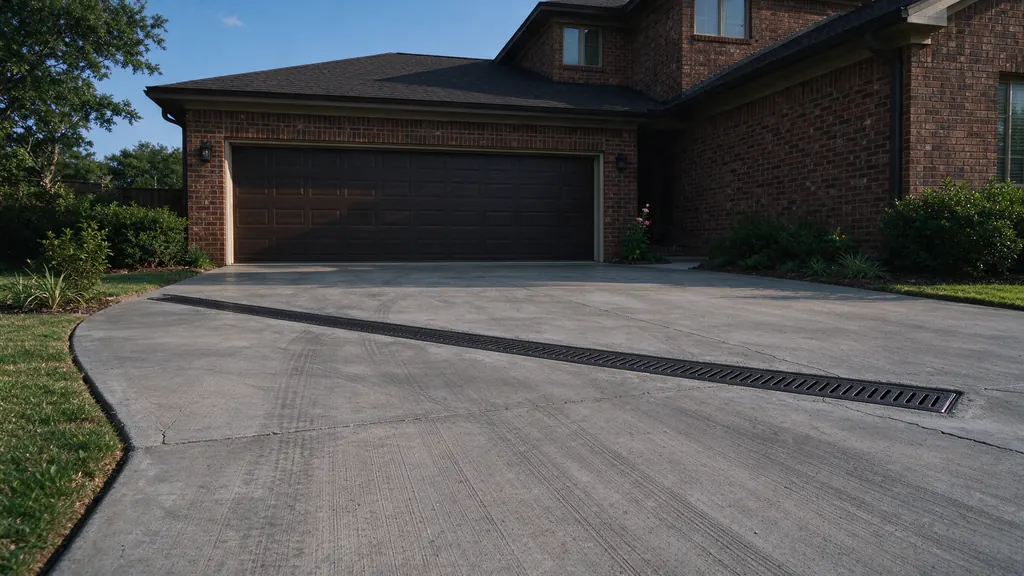
Why drainage belongs in the driveway decision
At Surefoot Houston Driveway Repair, we offer and manage drainage work that serves the driveway: correcting the slope of the pavement, adding surface drains in or beside it and directing runoff to a suitable outlet. A driveway that holds water ages faster. Water that sits on asphalt softens and strips it, water that runs under concrete edges washes out the base, and water trapped at a garage threshold reaches the building.
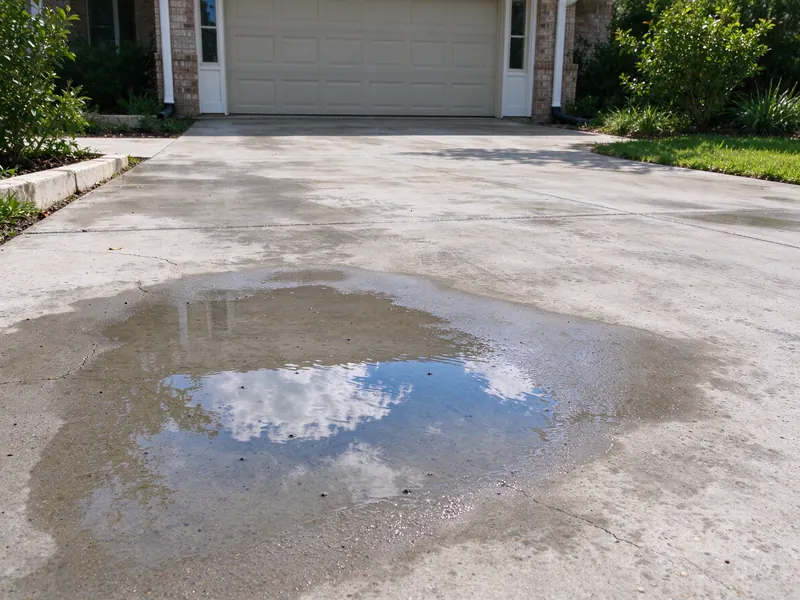
Harris County Flood Control describes the region's flat terrain and clay soils, and the National Weather Service lists a normal annual rainfall of 51.84 inches at Bush Intercontinental. With little natural fall, small errors in a driveway's slope decide whether water moves away or collects. Clay below the base loses strength when it stays wet, which is why many repeat repairs trace back to a water problem. Our guide to water pooling on a driveway explains how to read where the water collects.
Find the source of the water first
Drainage fixes fail when they treat the puddle instead of the source. Water on a driveway can come from roof downspouts discharging onto it, a lawn or bed that slopes toward it, a neighbor's runoff, a street gutter that backs up at the entrance, or a settled section of pavement that now forms a bowl. Each needs a different answer.
We look at the roof lines and downspouts, the grade of the yard and beds, the low points of the pavement and where water can leave the property, ideally with photographs taken during or right after rain. Settled concrete panels that create the low spot may need leveling or panel replacement as part of the fix. The point is to give the water a continuous path off the pavement to an outlet that can take it.
Regrade the surface where the slope is wrong
The most reliable drainage feature is pavement shaped to shed water. Where a section has sunk or was built nearly flat, the answer may be reshaping that area so it falls toward the street, a swale or a drain. On asphalt this can mean removing and relaying a section at a corrected grade. On concrete it usually means lifting or replacing the panels that hold water.
Fixed elevations limit how much the slope can change. The garage slab, the sidewalk, the street gutter and the doors set heights that the driveway must meet. We confirm those heights before promising a particular fall, and we say plainly when a site needs a drain because the surface alone cannot carry the water away.
Trench drains, downspouts and outlets
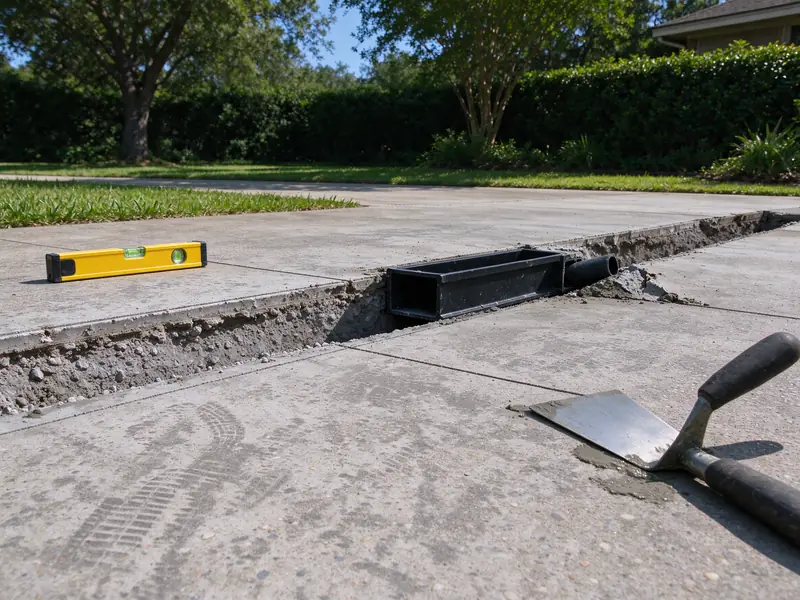
A trench drain, also called a channel drain, is a narrow grated channel set into the pavement to catch water running across it. It is most common across the driveway in front of a garage that sits lower than the street or the drive. The channel has to sit in a concrete surround that carries vehicle loads, use a grate rated for vehicles, and connect to a pipe that slopes to a working outlet. A trench drain with nowhere to discharge simply fills.
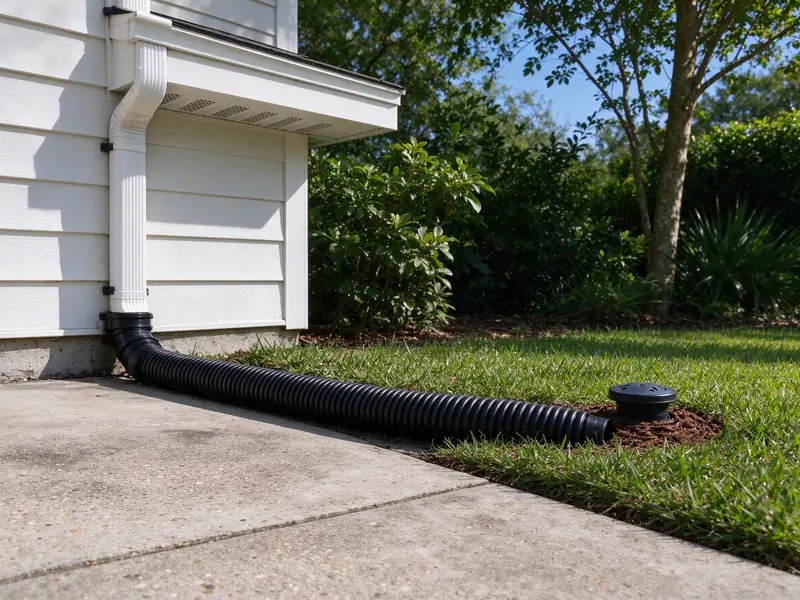
Downspouts that empty onto the driveway or against its edge can be extended or piped under the pavement to discharge farther away. Small catch basins can collect water at a low point beside the drive. Every one of these devices needs an outlet: a street curb, a swale, a ditch or another approved discharge point. Sending runoff onto a neighboring lot can create disputes and may conflict with local drainage rules, so the outlet is part of the design, not an afterthought.
Let's find where the water should go
Tell us where water collects on your driveway and send photographs taken during rain if you have them.
Request a drainage assessmentRoadside ditches, culverts and gutters
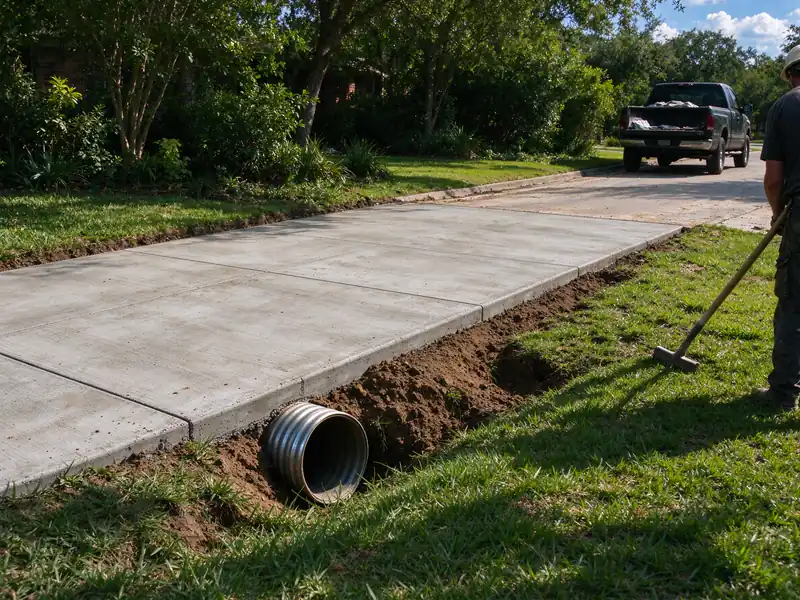
Some Houston-area streets drain through open roadside ditches, and driveways cross them on culverts. A culvert that is crushed, silted up or set too high can back water up along the ditch and over the entrance. A driveway on a curb-and-gutter street depends on the gutter carrying water past the opening. Either way, the entrance is part of the public drainage path.
Work on a culvert or within the right-of-way falls under the road authority. The City of Houston's driveway permit notes that a culvert must be installed before inspection, and Harris County ties driveway work in its right-of-way to the ditch. Our apron repair and curb cut pages explain that process, and the permit guide covers identifying the right office.
Rules that can apply in the City of Houston
Drainage changes that add pavement or alter grades can trigger review. The City of Houston updated the stormwater chapter of its Infrastructure Design Manual in May 2025, including criteria for impervious cover with minimal impact on the city's drainage system. The city's Floodplain Management Office issues a residential driveway permit for vehicle-access flatwork, and its site plan must show whether the paving matches existing grade.
Suburban cities and the counties have their own requirements. We identify which apply to the address before the work is scheduled rather than assuming a drainage correction on private property never needs review.
Where our drainage scope ends
This service covers drainage that serves the driveway and its entrance. Whole-yard systems, such as French drains around a house, subsurface drainage across a lot, sump pumps or foundation drainage, are a separate trade. If the driveway problem depends on one of those systems, we identify the dependency so it can be handled by the right specialist, and we do not promise that driveway work will solve flooding that starts elsewhere on the lot or in the street.
What changes the price of driveway drainage
Cost depends on whether the fix is regrading, a drain, or both; the length of trench drain and its grate rating; the distance and depth of pipe to the outlet; and how much pavement must be cut and replaced to install it. Culvert work, permit requirements, restoration of beds and lawn, and access for equipment also matter. Combining a drainage fix with a planned repair or replacement often saves cutting the same pavement twice. Review the Houston cost guide for the broader context.
What this work looks like
Questions about driveway drainage
Why does water collect in front of my garage after rain?
The driveway may slope toward the garage, a panel near the door may have settled, or downspouts may discharge there. Where the garage sits below the drive, a trench drain across the opening with a pipe to a working outlet is a common fix. Regrading may work where the levels allow it.
Does a trench drain need to connect to something?
Yes. A trench drain only collects water; it must discharge through a sloped pipe to an outlet such as the street curb, a swale or a ditch. Without a working outlet the channel fills and overflows. The outlet and pipe route are part of the design.
Can downspouts be piped under a driveway?
Often, yes. Downspout water can be carried in a buried pipe under the pavement to discharge beyond it, usually installed when that part of the driveway is being replaced or by cutting a narrow trench. The pipe needs enough fall and a protected outlet so it does not back up.
Will fixing my driveway drainage stop my yard from flooding?
Not necessarily. Driveway drainage controls water on and beside the pavement. Yard flooding can come from lot grading, the street or a neighborhood drainage problem. We explain what a driveway fix can change and identify when a whole-yard drainage specialist is needed.
Who fixes a clogged culvert under my driveway entrance?
Responsibility depends on the road authority and local rules for the address. Replacing or resetting a culvert is right-of-way work that usually needs approval. We help identify the authority and include the culvert in the scope only when its requirements are established.
Related planning guides
Get a drainage plan you can compare
Share the address, where water collects and where it could leave the property. We will help define the right fix.
Get an Estimate